Written by the Growthpolis team. We build Vista Checkout Rules, one of the apps compared below — we've disclosed that upfront so you can weigh our take accordingly. Every claim about a competitor here is sourced from that app's own Shopify App Store listing and public review history, linked at the bottom.
Shopify Scripts stopped executing entirely on June 30, 2026. If your store used Scripts for discounts, shipping rules, or payment customization, that logic is gone, and it isn't coming back without a rebuild.
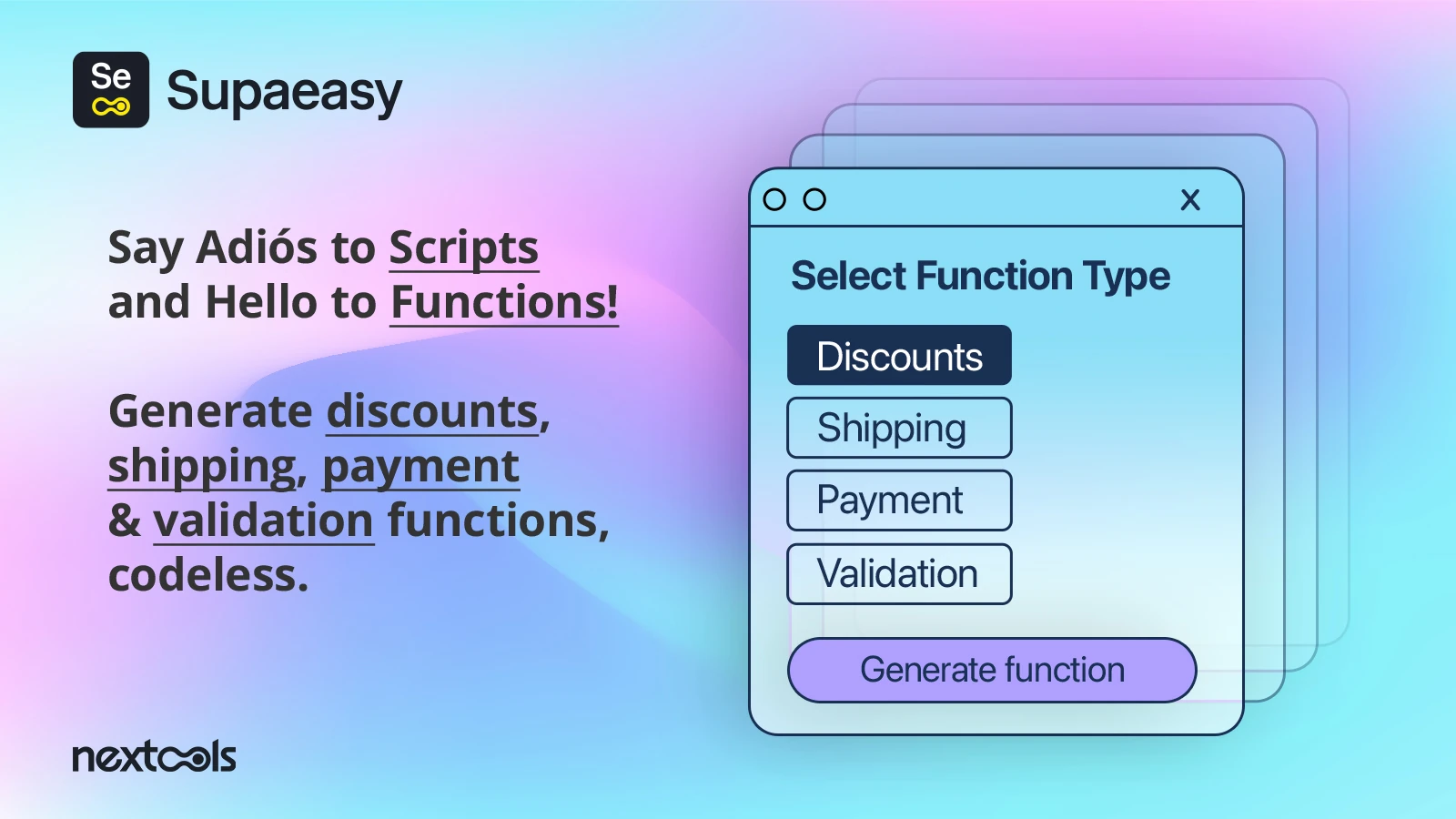
SupaEasy has become one of the go-to Shopify Functions apps for that rebuild — it's a ShopTank Editions winner with over 200 five-star reviews. But it's priced and built for a specific kind of merchant, and it isn't the only credible option. Here's how it actually compares to the alternatives, and which one fits your store.
Quick Answer
| App | Best For | Starting Price | Rating |
|---|---|---|---|
| SupaEasy | AI-prompted function generation + full Script migration | Free / $49–$399/mo | 5.0★ (210+) |
| Vista Checkout Rules | Budget payment/shipping customization + moderate discounts | Free / $3.99/mo | 4.9★ (12) |
| Function Junction Promos | Testing discount campaigns before committing to a subscription | Free, revenue-based (capped $900/mo) | 5.0★ (11) |
| PowerX – Discount Manager | High-volume discount stacking with migration support | Free (dev) / $39–$299/mo | 4.8★ (30) |
| Function Studio | Visual flowchart-style logic for complex, edge-case discounts | $19/mo | 5.0★ (14) |
| F: AI No-Code Function Creator | Testing an AI builder on a smaller budget | Free plan | New, limited review history |
Why Shopify Retired Scripts in Favor of Functions
It's worth understanding why this migration is mandatory, because it explains what to actually look for in a replacement. Shopify Scripts ran in a sandboxed Ruby environment that was isolated from the rest of the Shopify stack — no access to Flow automations, no GraphQL, no connection to Checkout UI Extensions. Every change needed a developer with direct access to the Script Editor, and there was no version control, no rollback, and no staging environment to test changes safely. That isolation — not simple age — is why Shopify chose to build a new system rather than patch the old one.
Shopify Functions solve this by running as WebAssembly (WASM) modules that execute in under 5 milliseconds, roughly 100x faster than the old Script Editor. More importantly for merchants, Functions are distributed as apps rather than pasted code, which means the logic lives in a version-controlled, testable package instead of a script with no undo button. That's the real reason every app in this guide — SupaEasy included — is built the same way: as a Functions-based app layer on top of that WASM runtime.
What You Can Do Without Any App
Before paying for any Functions app, it's worth knowing what Shopify's native tools already cover — because for simple use cases, you may not need one:
- Native automatic discounts: Shopify's built-in Discounts section supports Buy X Get Y, percentage, and fixed-amount discounts on all plans. This covers basic promotions in about five minutes of setup.
- Real limitations of the native tools: only one product-level discount applies per line item (if two automatic discounts target the same product, Shopify applies the larger one and silently ignores the other — they don't stack), there's no built-in way to display a tiered pricing table on the product page, and Buy X Get Y discounts require the customer to manually add the “get” item to their cart rather than adding it automatically.
- Draft Orders: for one-off manual adjustments (custom pricing for a single wholesale customer, for example), staff can build a Draft Order in the admin without any app or Function at all.
- Building your own Function: if you have developer resources, you can write and deploy a custom Function using the Shopify CLI in Rust or JavaScript/TypeScript, then activate it through the GraphQL Admin API. This gives you full control but requires ongoing maintenance — you're now the one testing edge cases and keeping the code current with Shopify's API changes.
If your needs go beyond what native discounts support — customer-tag-based pricing, multi-condition stacking, checkout-level payment/shipping customization — that's the actual point where a Functions app like SupaEasy or its alternatives starts to pay for itself.
What to Look for in a Shopify Functions Generator
- Discount function types: BOGO, tiered/volume pricing, buy-x-get-y, and automatic discounts triggered by customer tags, segments, or cart totals
- Checkout customization: hiding, sorting, or renaming payment and shipping methods by condition
- Cart/checkout validation: blocking risky orders, enforcing order limits, preventing overselling
- Migration depth: how much of your old Script logic the app can actually carry over vs. rebuild from scratch
- Plan restrictions: whether the functions you need are gated behind Shopify Plus
Vista Checkout Rules — Budget Pick for Payment & Shipping Customization
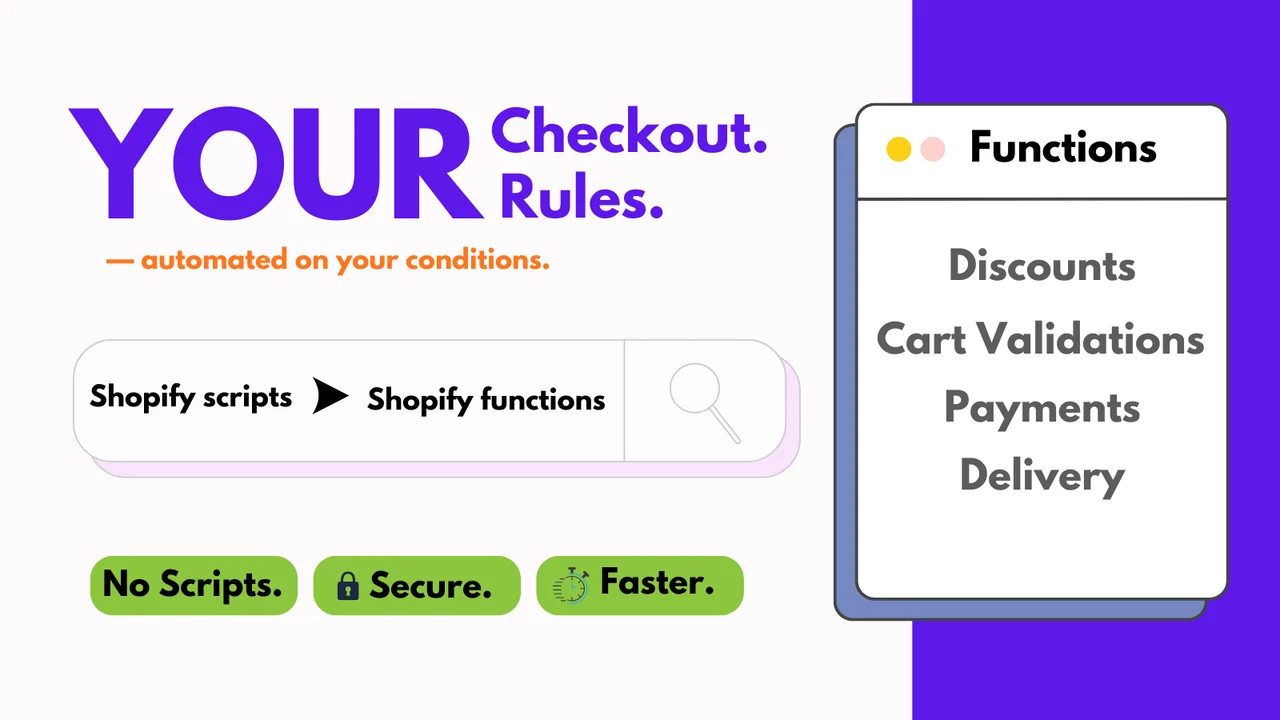
Disclosure: this is our app. Vista Checkout Rules uses Shopify Functions to hide, sort, or rename payment and shipping methods by condition (country, city, product tags, language, variant title, subscription plan, customer tags), plus automatic discounts — BOGO, buy-x-get-y, tiered pricing — that trigger from real products instead of virtual SKUs, which avoids the inventory-sync issues bundle-style discount apps sometimes introduce.
Honest trade-off: we built this specifically for payment/shipping customization plus moderate discount logic, not as an AI-prompt-based function generator like SupaEasy. There's no “describe what you want and let AI build it” workflow here — you configure rules manually through the admin UI. The free plan is also genuinely limited (one rule, one condition), so most stores will need the $3.99/month Basic plan to do anything meaningful. If your main need is complex, stacked discount campaigns rather than checkout customization, then you will have to opt for higher paid plans which are considerably cheaper than its competitors.
Function Junction Promos — Best for Testing Before Committing
Built by Presidio, Function Junction is a no-code campaign builder for discounts, bundles, BOGO, and shipping rules, with Promo Blocks to display active offers on your storefront. Its pricing model is the standout feature: free to install, with fees that scale as a percentage of the revenue those campaigns generate, capped at $900/month. That means you don't pay for capacity you're not using yet.
What we found researching its track record: it has a smaller review base (11) than the more established apps here, so there's less public history to judge long-term reliability against — but the reviews that exist specifically call out replacing Script-based discount logic without added dev overhead, which lines up with its stated purpose. If your discount campaigns will drive meaningful revenue, model out what the percentage-based fee actually costs at your expected volume before assuming “free to install” means low-cost long-term.
PowerX – Discount Manager — Best for High-Volume Discount Stacking
PowerX (CodeInspire.io) is built for scale: up to 50 automatic discounts per function, complex discount combinations, and the ability to import/export campaigns between staging and live stores — useful if you or an agency test changes before pushing them live. The Enterprise tier ($299/month) adds dedicated developer support and hands-on Scripts-to-Functions migration help.
What we found researching its track record: the technical feature set is genuinely deep, and reviews back that up for stores running high order volume. But we also found at least one detailed, recent public dispute in its review history where a merchant described an unresolved setup issue, and the developer's public reply pushed back on the merchant rather than de-escalating. That's one data point, not a pattern — the large majority of its ratings are still 5 stars — but if support responsiveness matters as much as the feature set to you, it's worth reading PowerX's most recent reviews directly before committing to a paid tier.
Function Studio — Best for Complex, Visual Logic Building
Function Studio (EasyLogicTools) takes a different approach from every other app on this list: instead of an AI prompt or a settings form, you build discount logic on a drag-and-drop flowchart canvas — branching conditions, overlapping bundles, tiered thresholds calculated after other discounts, multi-condition gift-with-purchase rules. It also supports multi-language discount messaging, useful for stores selling across several regions, and migration help from its team for Script-heavy stores.
What we found researching its track record: its review history is the most consistently specific of any app in this comparison — merchants repeatedly cite being able to block specific product combinations at checkout and handle edge cases that “form-based” discount apps couldn't express. The trade-off is scale: at 14 reviews, it has the smallest public track record here, and its free tier is capped at one active function on development/staging stores only — you'll need the $19/month plan to run it live.
F: AI No-Code Function Creator — Newest AI-Prompt Option
Built by Final Apps, this is the closest match to SupaEasy's AI-prompt workflow among the newer entrants: describe what you need and the AI builds the discount, shipping, payment, or validation function, with templates and live previews alongside it.
What we found researching its track record: there isn't much to find yet — it's new enough that review history is minimal. That's not a red flag by itself, but it does mean you're evaluating it on feature claims rather than a track record. Reasonable to test on a development store before trusting it with live checkout logic, given how little public usage data exists so far.
A Note on “Alternatives” That Aren't Really Alternatives
Worth flagging since it's easy to miss: SupaEasy is built by Nextools, and Nextools also owns Multiscount (a tiered-discount app) and SupaElements (checkout/thank-you page customization). Some “SupaEasy alternatives” roundups list those as competing options — they aren't. They're companion products from the same company, designed to be used alongside SupaEasy rather than instead of it. If you're specifically looking for an independent alternative rather than an add-on to the SupaEasy ecosystem, the five apps above are actual third-party competitors; Multiscount and SupaElements are not.
Choosing the Right Platform for Your Situation
With Scripts already off, the real question isn't whether to migrate — it's which tool matches how you'll actually use it:
- Mainly need payment/shipping customization on a budget → Vista Checkout Rules
- Want to test discount campaigns before committing to a subscription → Function Junction Promos
- Running high discount volume or want dedicated migration support → PowerX
- Have genuinely complex, edge-case discount logic → Function Studio
- Want an AI-prompt workflow like SupaEasy's, at a lower starting cost, and are willing to test on a dev store first → F: AI No-Code Function Creator
- Want the most-reviewed, most established all-in-one option and don't mind the higher price tier → SupaEasy itself remains a reasonable default, particularly if the AI-generation workflow and full-service support matter more to you than price
Whichever you choose, test on a development store first. Functions don't behave identically to the Scripts they replace — the input format is different (GraphQL instead of Ruby objects) and edge cases your old Scripts quietly handled can surface unexpectedly. Better to find that out before your discount logic goes live, not after.
Sources:
- Shopify Help Center — Transitioning from Shopify Scripts to Shopify Functions
- Shopify Community — Shopify Scripts Deprecation announcement
- Shopify Scripts deprecation timeline and architecture — flatlineagency.com
- Shopify native discount limitations — bogos.io tiered pricing guide
- Vista Checkout Rule & Discount — Shopify App Store
- Function Junction Promos — Shopify App Store
- PowerX – Discount Manager — Shopify App Store
- Function Studio — Shopify App Store reviews
- F: AI No-Code Function Creator — Shopify App Store
- Multiscount: Tiered Discounts — Shopify App Store
1 thought on “Best SupaEasy Alternatives”
Comments are closed.