Last week in my newsletter, I wrote about how AI shopping assistants are quietly changing e-commerce.
How tools like ChatGPT, Claude, Perplexity, and Copilot are starting to influence which products customers even see.
This week, Shopify made that shift much more real.
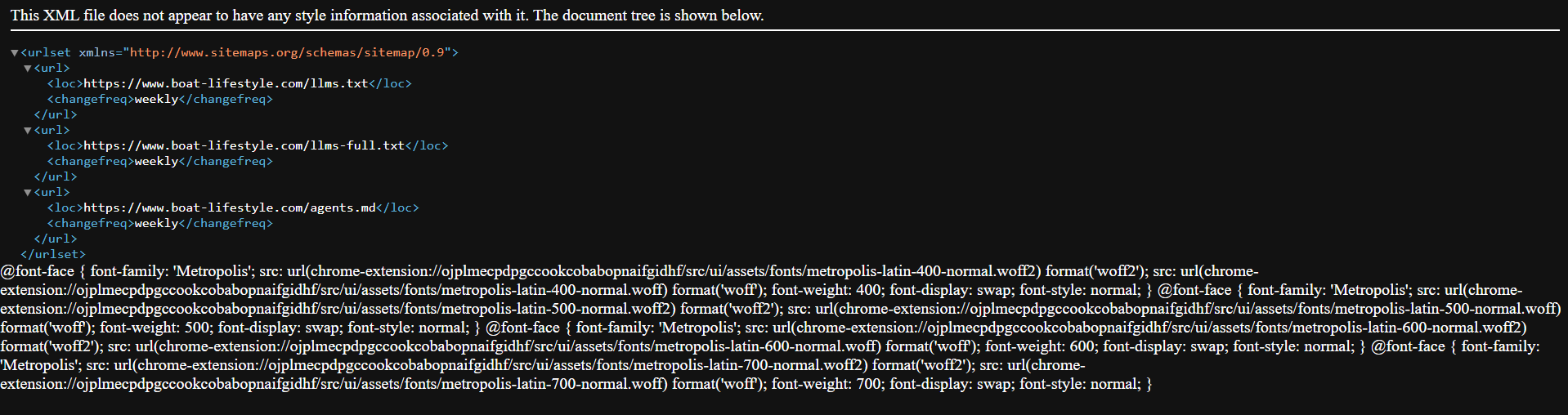
They just rolled out a new set of AI-facing files across Shopify stores:llms.txt, llms-full.txt, and agents.md.
Most merchants probably won’t notice them. But AI agents absolutely will.
If you check: yourstore.com/sitemap_agentic_discovery.xml
You will now find a structured “instruction layer” designed specifically for LLMs and shopping agents.
And this changes something important:
For years, the internet was built around humans browsing websites.
Now stores are starting to communicate directly with AI systems too.
The old e-commerce model was simple
Websites were written for humans.
- Google bots crawled pages.
- Search engines ranked them.
- Customers clicked links.
- Humans did the shopping.
But AI agents don’t behave like traditional search engines.
They don’t want to interpret your homepage banner.
They don’t want to guess what your collections mean.
They don’t want to fight popups, sliders, animations, or vague product copy.
They want structured information.
- Clear product data.
- Policies.
- Capabilities.
- Pricing.
- Checkout rules.
- Inventory access.
- Machine-readable context.
That’s exactly what Shopify just enabled.
What Shopify actually added
llms.txt
This acts like a high-level briefing for AI systems.
It tells agents:
- What the store sells
- How to browse products
- contact information
- Discovery endpoints
- Integrations like MCP/UCP references
Think of it as:
“Here’s how to understand this store.”
llms-full.txt
This goes deeper.
It exposes structured product and collection endpoints along with Storefront API references.
Instead of scraping HTML pages, AI agents can directly pull clean product data in structured formats.
That matters because AI systems perform significantly better with structured information than with visual webpages.
agents.md
This is the most interesting piece.
It explains how an AI agent should actually interact with the store.
How to:
- search products
- build carts
- initiate checkout
- finalize purchases
- respect rate limits
- pass buyer context
- handle approval flows
In simple terms:
Shopify is preparing stores for AI-assisted purchasing workflows.
Not just AI-assisted discovery.
That distinction matters.
Why this is a bigger shift than it looks
For the first time, Shopify stores now have an official machine-facing layer.
Not SEO. Not UX. Not conversion optimization.
It's Agent optimization.
And this aligns perfectly with the “agentic shopping” shift I talked about last week.
The stores that AI can understand clearly will likely become easier for AI systems to recommend confidently.
The stores that remain ambiguous may slowly become invisible inside AI-driven shopping experiences.
The part merchants should pay attention to
Shopify generated these files automatically. But the defaults are extremely generic.
Many stores currently have:
- weak summaries
- incomplete policy context
- poor differentiation
- inaccurate metadata
- unclear brand positioning
And AI agents will literally consume that information.
One interesting detail:
Shopify also inserts a promotional block about starting a Shopify store inside these files.
Meaning every AI crawler visiting your store also sees Shopify’s branding embedded into your machine-readable layer.
That alone tells you how important Shopify believes this ecosystem will become.
What should merchants do now?
This is probably the first practical “AI visibility” checklist for e-commerce stores.
A few things worth reviewing immediately:
- Rewrite the default store summary
- Add meaningful brand differentiators
- Make shipping and return policies explicit
- Verify currency and contact information
- Ensure structured product data is complete
- Remove unnecessary generic filler where possible
Most stores are still early here.
That window won’t stay open forever.
Because once AI shopping becomes mainstream, structured clarity may become as important as SEO has been over the last two decades.
And unlike SEO, almost nobody has years of optimization advantage yet.
1 thought on “Shopify AI: Why Shopify Stores can’t Ignore LLMs.txt?”
Comments are closed.