Written by Navdeep Soni — Shopify & SEO consultant, founder of GrowthPolis, 5+ years optimizing Shopify stores for organic growth.
Today, we will dive into a Shopify SEO case study of an Indian saree brand — how it grew monthly sales from Rs. 58,650 to Rs. 1,53,637 (a 161% increase), while organic sessions grew from 1,017 to 2,464 (a 142% increase) in the same window.
The current Indian saree market is more than Rs. 55,000 crore in FY26 and is expected to cross Rs. 61,000 crore by the end of FY27. It will be approx 1 lakh crore by the end of 2034 with a CAGR of 6.54%. These are not small numbers by any stretch of the imagination.
For this reason, the online market has already attracted big players like Avantra by Reliance Trends and Taneira by Tata, as well as marketplaces like Myntra, Meesho, Flipkart, Amazon, etc.
The good news is that smaller brands that work directly with weavers and have unique designs and craftsmanship can compete with these established brands.
However, there is a common mistake that a new brand usually makes while hiring an SEO company when it launches its e-commerce store.
They rely “only” on paid marketing. They undervalue the potential of organic traffic and the ROI it offers over a longer period.
This is what I noticed when I onboarded Forsarees, a Mumbai-based saree brand. The source of traffic and leads was heavily dependent on the ads they were running on Instagram and Google.
About ForSarees
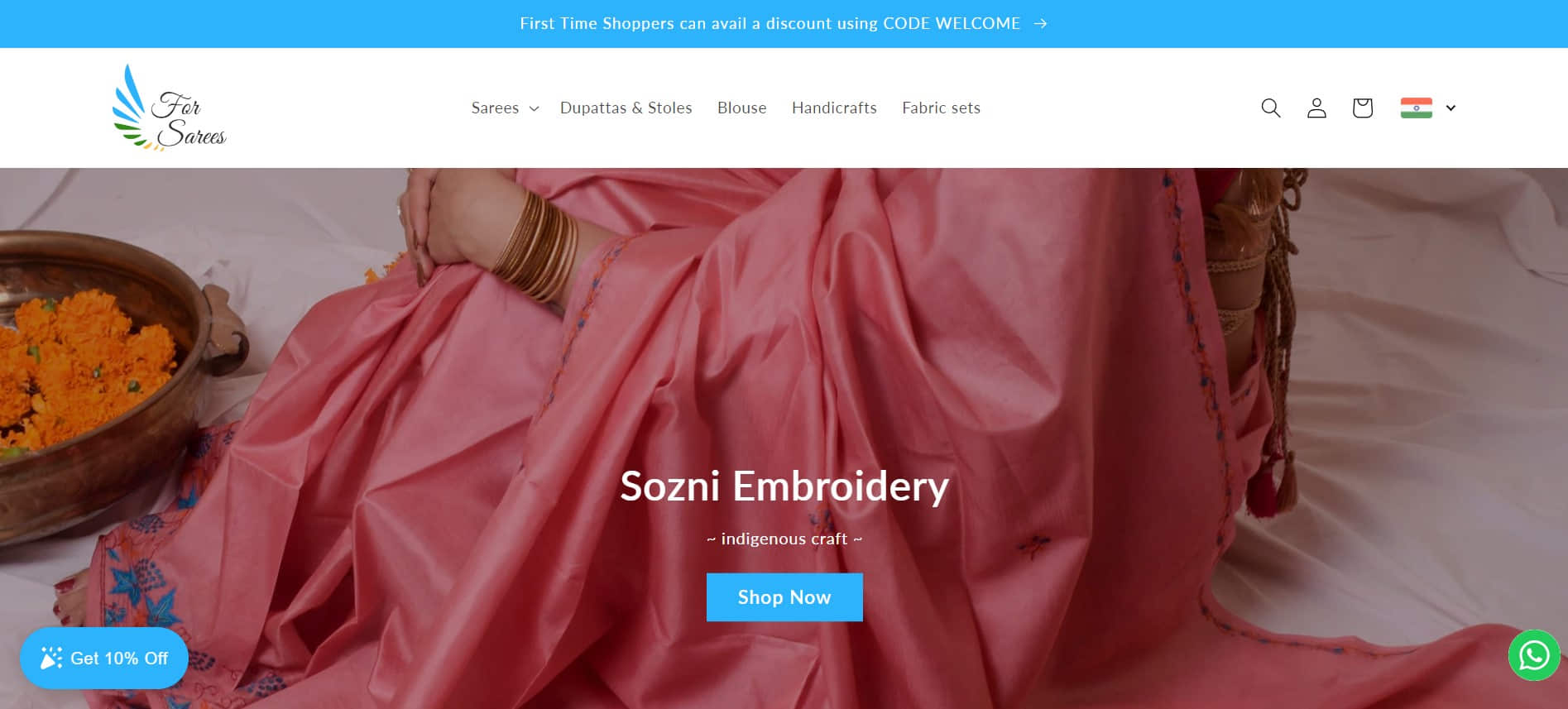
Forsarees was founded in 2018 by Ritu Oberoi for the sheer love of sarees. Ritu is a first-time founder with zero experience in the business and fashion industry. She built her brand with her unique storytelling and hard work.
She would actively post pictures of herself and her friends wearing sarees on Instagram. Those real, authentic pictures resonated with avid saree-loving women. As expected, women wanted to buy those beautiful sarees. She started getting orders on Instagram and through her e-commerce store.
With Shopify, you can easily place and track orders and inventory. This allowed her the headspace to work with weavers and expand her business.
Soon, she started investing in SEO and online ads.
The ppc ads, or Meta ads, did help boost the number of monthly orders, but organic traffic did not increase as per her expectations. She had to rely on ads and social media reach. But this dependency can be tricky for any business.
If you Google any saree, you will notice that the first page of Google shows almost the same brands in both ads and organic results. Every brand wants to acquire as much real estate as possible in the online world for better conversions.
In today's competitive world, you cannot ignore ads or organic search results. You have to be there wherever your customers are hanging out in the online world, and this is where an audience-first SEO approach helped us get faster results.
So it is evident that if Forsarees has to scale and reach the next level, it has to level up its strategies.
How did I achieve 161% growth in 3 months for this Saree Brand?
Before and After Data
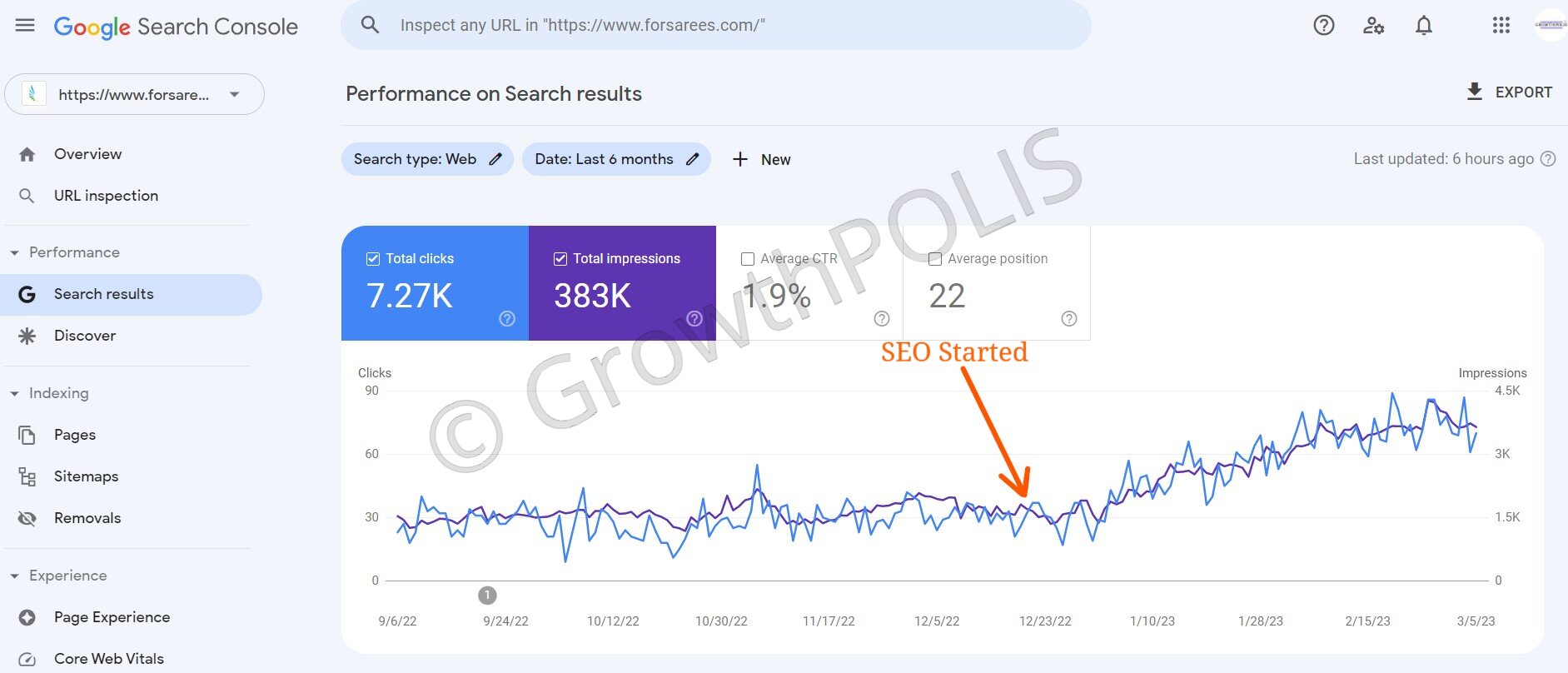
Let us look at the numbers and data to understand where the brand stood in terms of organic traffic before we started working and after the first round of optimization.
All traffic and revenue figures below are pulled directly from Forsarees' Google Analytics and Search Console, shared with the brand's permission for this case study.
Forsarees was getting approximately 905 users/month with 1017 sessions/month as of Nov-2022 from Google search. I started working on the Shopify store on 19th Dec 2022, and in less than 3 months, the number of sessions increased from 1017 to 2464. That's a whopping 142% growth in the number of sessions.
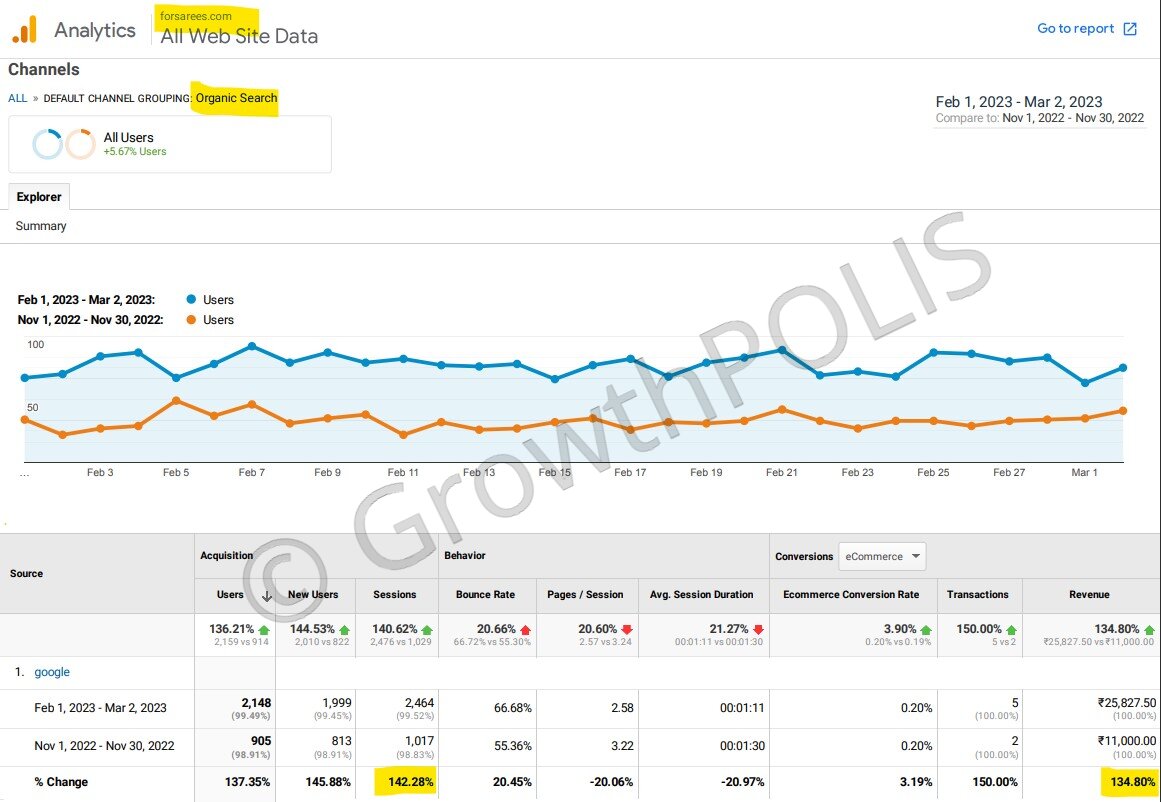
An increase in the number of sessions is crucial for any brand. It increases your chances of conversion/sale by multiple folds.
As an SEO and Shopify consultant, my first goal is to increase organic traffic. The CRO (conversion rate optimization) techniques will be more effective once you test them out on a considerable amount of traffic. The copy, UI design, relevancy, quality of products, etc have to be on point for a good conversion rate.
How much was the increase in saree sales?
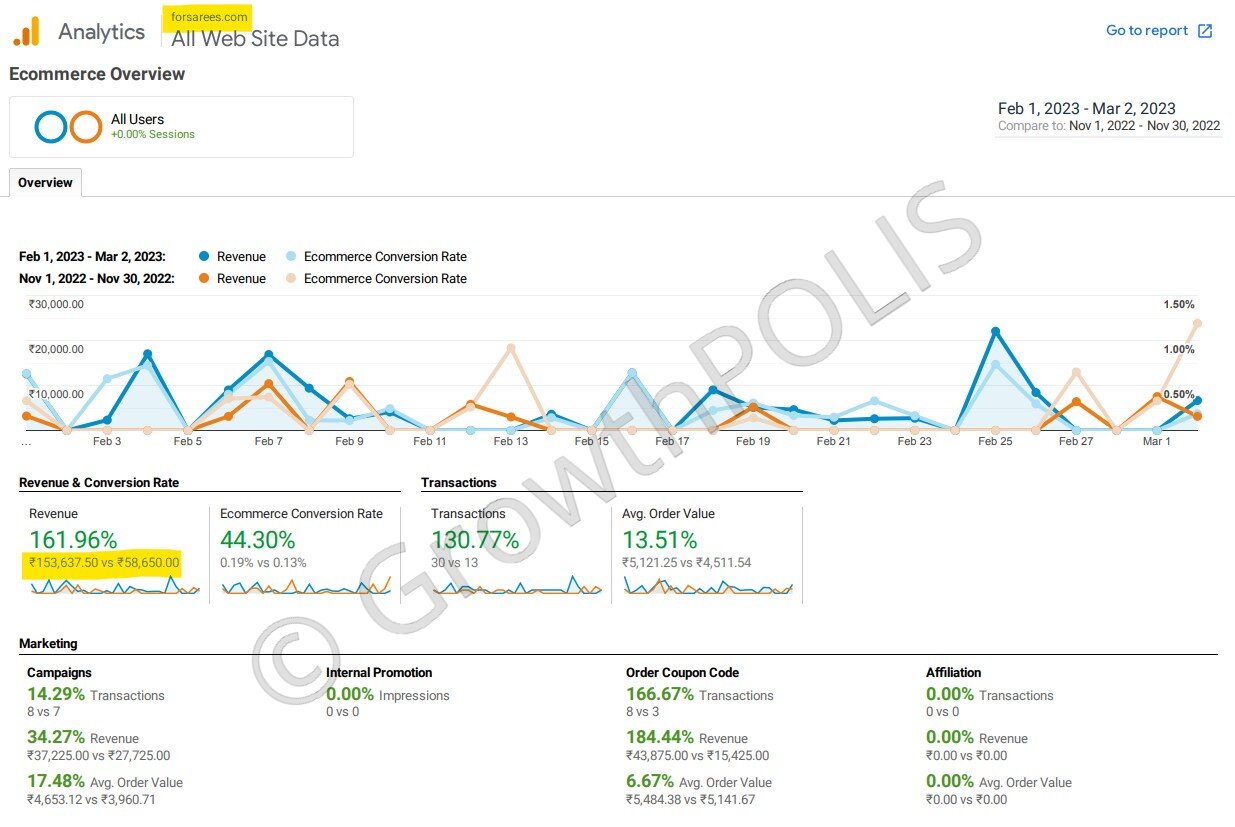
In 2022, the average monthly sale of sarees was around Rs. 55,000 (Rs. 58,650 to be precise). After I started working on the store, it reached over Rs. 1,50,000 (Rs. 1,53,637 to be precise) — a 161% increase in sales.
What SEO Optimizations Boosted this Shopify Store?
Most SEO-related changes are broadly categorized into technical SEO, on-page SEO, and off-page SEO.
I did not invest any time or money into off-page SEO or building backlinks. There were two reasons.
Firstly, the store had quite a lot of work sorting out technical and on-page optimization issues. It made no sense to focus on all areas of Shopify SEO simultaneously.
Secondly, the client had a limited budget, and it made more sense to make sure the store was in proper shape to leverage the full advantage whenever backlinks are built.
I always keep a journal for each store I work on. It helps me to keep track of every change I make. It is the easiest way to see any sudden changes in traffic. I get to learn what changes have more impact when dealing with certain kinds of issues.
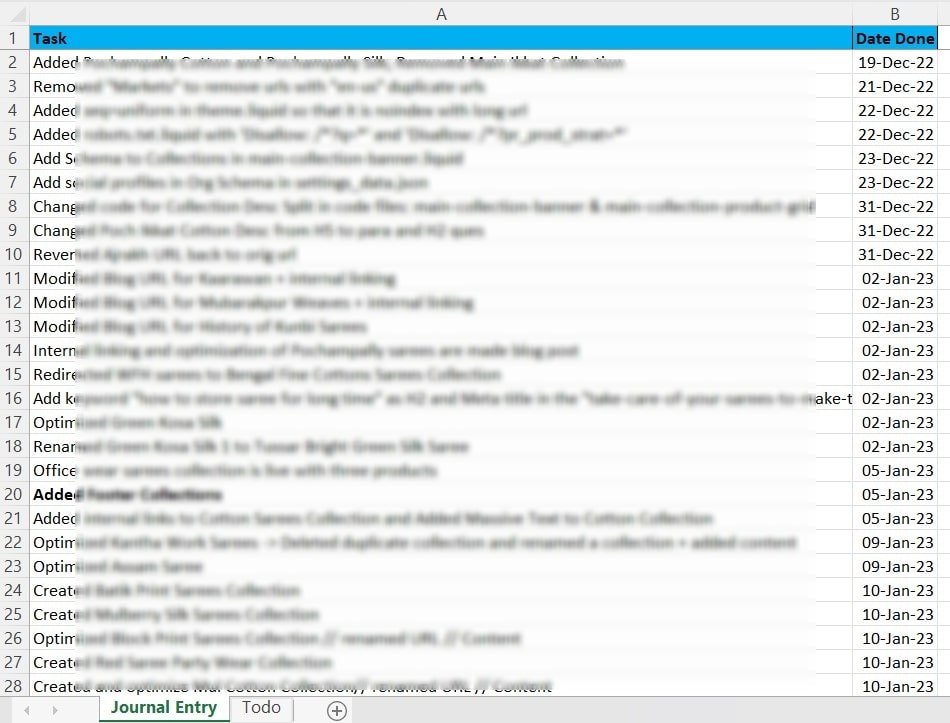
Here are some key changes I made in terms of Technical SEO and On-page SEO, with my comments on why they were needed.
404 Errors and 301 Redirect Issues
404 errors on any site are bottlenecks for crawlers to move freely and understand your content. Don't make Google crawlers work hard. Therefore, removing 404 errors is the first thing I do. I rectified all 404 errors and any 301 redirects.
Out of Stock Products
In most e-commerce sites, this is a fairly common problem and a major contributor to 404 errors. I have noticed many store owners delete discontinued products and sometimes even out-of-stock products.
This, on a surface level, does not look like a big deal for them, but it creates technical issues. Never delete a product (URL) permanently; instead, redirect to a relevant product page to pass on any kind of equity it has earned in its lifetime.
Similarly, for out-of-stock products, capture emails to notify the customer when it is available or let it stay as is instead of deleting it and recreating it when it is available.
Site Speed
Site speed is an issue with most Shopify stores, and further customization of theme templates creates more issues. As a software engineer, I instinctively go and check the code to get the scope of speed optimization.
On this store, most of the load-time hit was coming from [placeholder: e.g., unminified/render-blocking JS loading synchronously in the theme header, or oversized uncompressed hero images] — the kind of thing that doesn't show up on a visual scan, only once you actually check the load waterfall in dev tools.
In this case, the speed issues were handled by the developer hired by the owner and the Shopify support team. Even though there is some improvement, the client opted to stay with the current theme and code since hiring a more experienced developer was costly.
Messed up Headings
Again, it is a fairly common occurrence; most Shopify themes have heading hierarchy issues. The H2 and H3 were assigned to irrelevant terms like cart, comments, search, subscribe, etc., instead of product names in a collection.
I made changes to the Shopify code and sorted this out.
Reorganizing Products into New Collections
Most store owners make collections keeping UI/UX in mind. Although this is fine, proper keyword research is required to attract organic traffic.
A fine balance between the two results in an optimized collection with more chances of ranking on Google. I took the approach of creating collections that were more niche as broader collections will require more topical authority and a strong backlink profile.
Meta Titles
Meta titles should be apt and to the point, looking at the user intent. Also, smartly adding your primary keyword without making it look obvious also helped.
For example, most product titles on the store followed a generic [Product Name] – [Store Name] pattern.
I restructured them to lead with the attributes buyers actually search for: fabric, weave/technique, then brand, something closer to
[Fabric Type] [Weave Style] Saree Online | [Brand]
rather than burying the keyword-relevant terms after the brand name.
Collection Description
I added a description to each collection using related keywords and entities. This provided much-needed information and support to each collection so that they could rank higher.
Most collection pages had either no description or a single generic line like “Explore our collection.” I replaced these with a couple of short paragraphs naming the actual saree types, weaving regions, and occasions relevant to that specific collection — the kind of entity and context signal a thin collection page is usually missing.
Added Blog Posts
I also added a few blog posts related to the sarees that were more informative. Also did on-page optimization of existing posts so they rank better, with internal links to products and collections.
Renaming Products and Changing URLs
As a part of on-page SEO, many products were renamed based on their key attributes. I also noticed that many product urls were not optimized or used irrelevant words not related to the primary keyword. Hence, in many cases, the products and collection URLs were renamed.
Duplicate H3 headings
There were duplicate H3 headings that were being created in every collection, which diluted on-page SEO. This was again related to the theme code, and I had to dig into the code and make changes. But it was worth the effort.
Duplicate Products
There are a lot of products in every store with minor variations in different collections for a better user experience. They have 95% similar specs and descriptions. They can technically fall under duplicate products, but physically they are not.
For example, the same saree might legitimately appear in both the “Banarasi Sarees” collection and the “Wedding Sarees” collection, with near-identical title and description in each. Rather than rewriting near-duplicate copy for every combination, canonical tags pointing to a single primary product URL let the collection variants exist for shoppers without splitting ranking signals across near-identical pages.
The best way to deal with such situations is to add appropriate canonical tags or simply use filters if the theme has a feature.
One Year Update: 30 Users to 200 Users
Many SEO agencies use black hat SEO techniques that can get you results in the short term, but then the traffic tanks within a few months. Consistent growth in your traffic is what one should aim for rather than a sudden spike. SEO is often considered slow, but the magic is in compounding and is clearly visible within a few months.
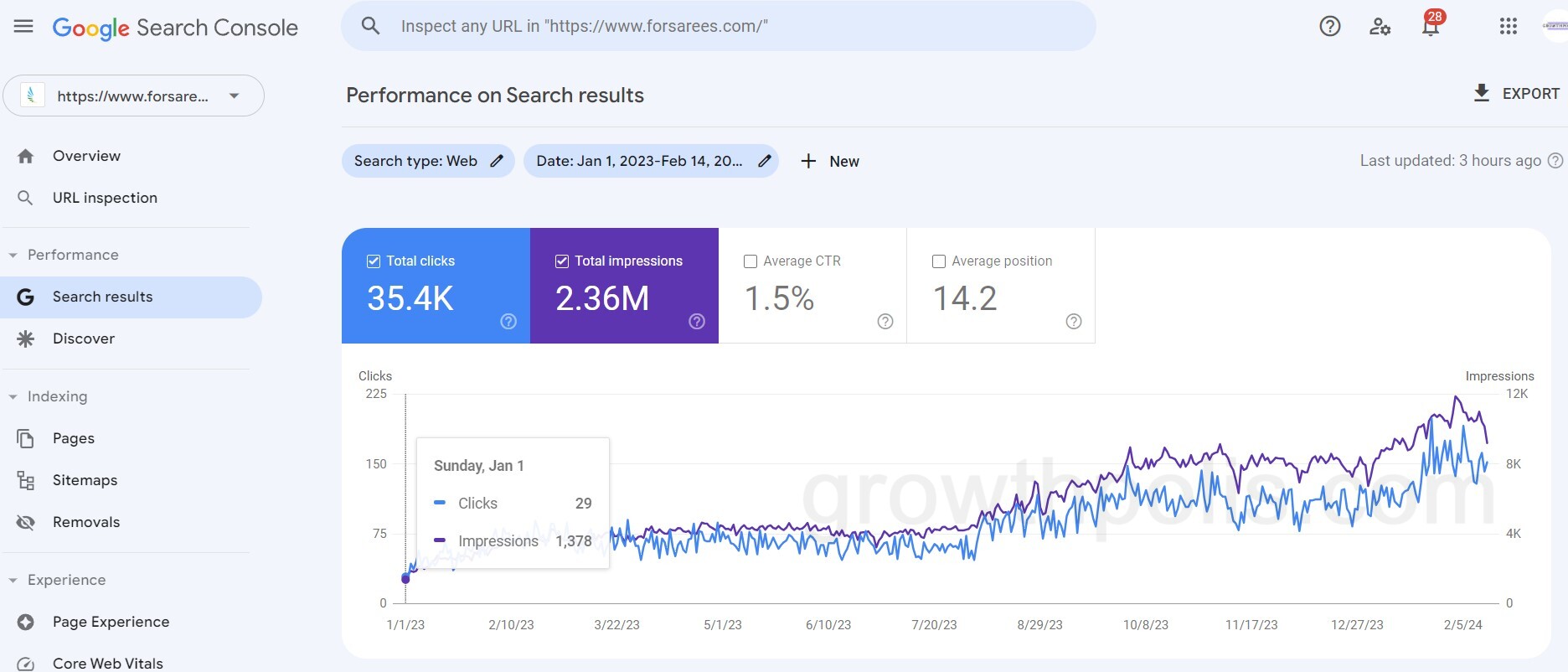
Here in the screenshot, you can see that in January 2023, the average organic daily clicks were around 30. One year later, in February 2024, it has grown month after month and is now at 200 daily clicks.
What Next for Forsarees
The client store has a poor backlink profile, and it has to be immediately addressed. The website has to gain authority, and it can be best achieved with a vote of confidence (link back) from other authoritative sites in related niches.
Due to budget constraints, I was not able to add more blog posts, but they are essential in attracting a target audience by creating How-to and What-is guides. The website needs more relevant informational content in the form of blog posts.
Conclusion
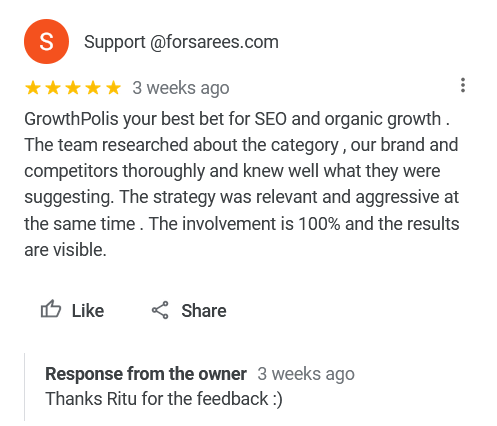
I did get a thumbs up from the client, but..
SEO results are not always as quick as you saw in this case, but they do provide better ROI. It all depends on the website's current state, history, competitors, and niche.
Hence, the pace of results can vary. The best time to start SEO was a year ago, and the next best time to start is today!
If I were starting this engagement over today, I'd push for backlink budget from month one instead of treating it as a phase-two item — the technical and on-page work tends to compound faster once authority-building runs in parallel rather than after.
If you want to take your store to the next level or you are planning to launch your store, get in touch with me. We provide ready-to-launch Shopify stores so that you save your time and headaches. Get in touch with me now!
What are some unconventional ways to promote Shopify apps and increase user engagement?
Partner with Shopify agencies