
Choosing between Shopify and Odoo is one of the most common decisions online sellers face, and it's rarely a simple one. Shopify is a hosted, ecommerce-first platform built to get a store online fast, while Odoo is an open-source business suite that includes an ecommerce module. Both can power an online store, but they're built for different jobs.
Shopify now runs on over 6.2 million live websites, while Odoo counts more than 12 million users worldwide across its full suite of business apps. Shopify alone generated over $292 billion in Gross Merchandise Volume in 2024, and by Q2 2023 was reporting $3.2 billion in quarterly revenue with roughly a 25% share of the global ecommerce platform market. These numbers matter because they reflect two different value propositions: Shopify's massive, ecommerce-dedicated ecosystem versus Odoo's all-in-one operational depth.
Below, we go past the checklist: real 2026 pricing as listed on both sites, the specific technical reasons each platform behaves the way it does, and the patterns that show up when you cross-reference thousands of verified user reviews on G2, Capterra, and Trustpilot rather than just reading the sales page.
Quick Verdict
If you're a DTC, retail, or subscription brand that wants to sell online without hiring an in-house dev team, Shopify is the more practical, lower-risk choice; its support, app ecosystem, and predictable pricing are built around merchants, not IT departments. Odoo makes sense if ecommerce is a secondary function bolted onto a company that already runs (or plans to run) manufacturing, multi-entity accounting, or complex distribution through Odoo's ERP.
| Factor | Shopify | Odoo |
|---|---|---|
| Best for | DTC/B2C stores, fast launch | Businesses needing full ERP + basic ecommerce |
| 2026 entry pricing | $39/mo (Basic), $29/mo billed annually | $31.10/user/mo (Standard, intro), renews at $38.90 |
| Support model | 24/7 chat on all paid plans; phone/priority on Plus | Email support, business hours (24/5), no live chat on Standard |
| Setup speed | Hours to days | Weeks, often with a paid implementation partner |
| Review score pattern | 4.5/5 on G2/Capterra, but sub-2/5 on Trustpilot | 4.2–4.3/5 on G2/Capterra, support sub-score consistently ~0.3–0.6 points lower |
Core Features: Why the Two Platforms Behave Differently
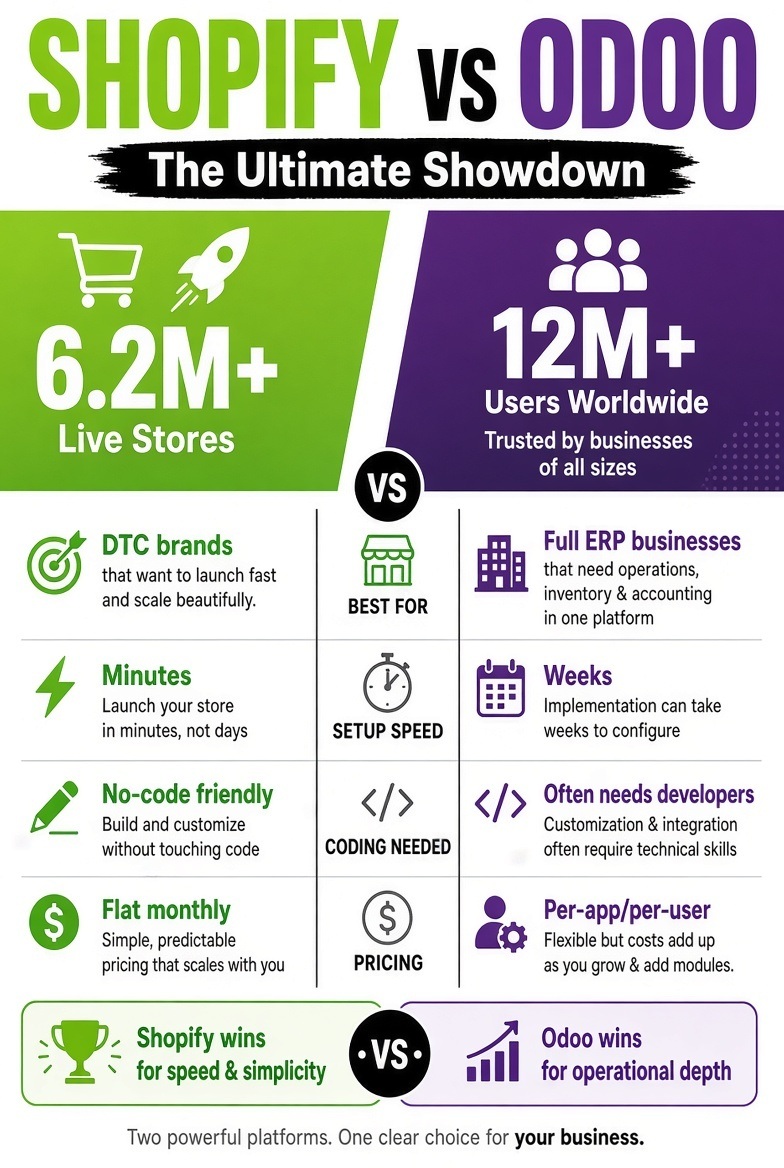
Shopify and Odoo aren't just different in feature count — they're built on fundamentally different architectures, and that's why their limitations show up where they do.
E-commerce Tools: Shopify is a multi-tenant SaaS platform purpose-built for a single job: running an online storefront and checkout. Every merchant runs on the same hardened checkout and payments layer, which is why features like abandoned cart recovery, discount codes, and localized checkout work reliably out of the box. Odoo's Website/eCommerce module is one of roughly 80 interconnected apps sharing a single PostgreSQL database and Python codebase.
That's powerful for connecting ecommerce to accounting and inventory in real time, but it also means the storefront isn't a dedicated product — it's a module competing for the same backend resources as your inventory, HR, and manufacturing apps.
Inventory Management: This is Odoo's strongest technical argument. Because inventory, purchasing, and manufacturing sit in the same database as the storefront, stock levels, bill-of-materials, and multi-warehouse routing update in the same transaction as a sale — no external sync required. Shopify's native inventory is solid for straightforward retail but wasn't built for manufacturing-driven stock (BOMs, work orders); most merchants who need that plug in a dedicated app instead of an ERP.
Customization: Shopify's Liquid templating language lets non-developers restyle a store using themes and apps without touching the checkout's core logic. Shopify deliberately limits checkout customization on non-Plus plans for PCI-compliance and fraud-prevention reasons, which is the same underlying reason most SaaS checkouts (not just Shopify's) lock down post-payment order edits.
Odoo, by contrast, exposes its ORM directly, so a developer can alter almost any workflow at the cost of needing that developer, and of custom modules sometimes breaking on version upgrades, as we have experienced with a few clients.
Ease of Use and Support: Where the Review Data Diverges Sharply
Star ratings alone don't tell the real story here — the gap between functionality ratings and support ratings is where the two platforms actually differ.
Odoo currently sits at 4.2/5 functionality on Capterra but drops to roughly 3.9/5 on customer service; G2 shows a similar 0.6-point gap between “meets requirements” and “quality of support.” The recurring complaint pattern across G2, Capterra, and Trustpilot isn't that Odoo's software doesn't work; it's that support responsiveness drops sharply after the contract is signed, and that Odoo's paid “Success Pack” implementation add-ons create sales pressure and cost surprises that weren't obvious at checkout.
One frequently echoed pattern in verified reviews describes system slowdowns during high-traffic periods, a store's cloud sync between the storefront and warehouse module stalling for several minutes during a Black Friday rush, at the exact moment staff needed it most.
Shopify's pattern is almost the inverse. On G2 and Capterra, Shopify holds a strong ~4.5/5, largely because day-to-day usability really is high — most merchants can go from signup to a live store in hours. But its Trustpilot score tells a very different story, often sitting below 2/5, driven almost entirely by support-access complaints: phone and priority support are reserved for Shopify Plus, so Basic, Grow, and Advanced merchants are limited to chat and email, and a recurring complaint involves being passed between agents on account or billing issues. Shopify also drew criticism in 2025–2026 for tightening what's included on lower plans (such as reducing staff accounts on Basic), which is worth factoring into a long-term cost comparison, not just the sticker price.
The takeaway: Shopify is easier to learn and use day-to-day; Odoo is more capable once configured, but that configuration and post-sale support gap is the single most consistent complaint across independent review platforms — not app-count or feature depth.
Integrations and Ecosystem
Shopify's App Marketplace lists over 13,000 apps, most installable through OAuth in a few clicks, covering everything from shipping to marketing automation to order editing. This app-first model is why niche functionality (like adjusting an order after checkout, or applying custom checkout rules) is typically solved by installing a focused app rather than by requesting a platform change from Shopify itself — the platform is deliberately extensible at the edges rather than deeply customizable at the core.
Odoo takes the opposite approach: since ecommerce already lives inside the same system as inventory, CRM, and accounting, many integrations that would be third-party apps on Shopify (like syncing an order to your books) are simply built in. Odoo does connect to Shopify itself through XML-RPC-based connectors for two-way order, product, and inventory sync — a common setup for companies that want Odoo running their back office while keeping Shopify as the customer-facing storefront.
Pricing: The Real 2026 Numbers
Pricing pages rarely show the full picture. Here's what each platform actually costs once you include processing fees and support access.
Shopify (verified from Shopify's official pricing, 2026):
- Basic: $39/mo ($29/mo billed annually) — 2.9% + 30¢ per online transaction with Shopify Payments; add 2% if using a third-party processor
- Grow: $105/mo ($79/mo annually) — 2.7% + 30¢; 1% third-party surcharge
- Advanced: $399/mo ($299/mo annually) — 2.5% + 30¢; 0.6% third-party surcharge
- Plus: from $2,300/mo — negotiated processing rates, typically 2.15–2.45%
Odoo (verified from Odoo's official pricing page, 2026, US list price):
- One App Free: $0, unlimited users, single app
- Standard: $31.10/user/month introductory (renews at $38.90/user/month) — all apps, Odoo Online hosting, email support only
- Custom: $61.00/user/month introductory (renews at $76.20/user/month) — adds Odoo Studio, multi-company, external API access, and self-hosting options
The comparison that matters isn't the sticker price — it's what each model does as you scale. Shopify's transaction fee disappears entirely if you use Shopify Payments, so a single flat monthly fee is genuinely the full cost for most merchants. Odoo's per-user pricing means a 10-person team on Standard pays roughly $3,700–$4,700/year in licensing alone before implementation, and that Odoo review data consistently flags Success Pack implementation fees and post-renewal price jumps (Standard renews about 25% higher than its promotional rate) as the real source of budget surprises — not the advertised sticker price.
Scalability, Multi-Currency, and Business Model Fit
Shopify Plus is purpose-built for high-growth brands: it handles Black Friday-level traffic spikes on Shopify's own infrastructure, and includes native multi-currency and multi-language selling for international expansion. Odoo scales differently — by adding modules as operational complexity grows (manufacturing, multi-entity accounting, complex logistics) — but that scaling is managed by your team or an implementation partner rather than handled automatically by the platform.
For B2B specifically, Odoo's native quote-to-cash and multi-company structure has historically been more mature out of the box, though Shopify B2B (available on Plus) has closed much of that gap with tiered pricing, company accounts, and custom catalogs — worth evaluating directly against your B2B requirements rather than assuming either platform automatically wins.
Frequently Asked Questions
Which is better, Shopify or Odoo?
For most SMB and DTC brands prioritizing speed to launch and predictable support, Shopify is the stronger fit. For businesses that need ecommerce tightly integrated with manufacturing, multi-entity accounting, or complex distribution, Odoo's all-in-one model can justify its steeper setup and per-user cost.
Who is Shopify's biggest competitor?
WooCommerce, Magento (Adobe Commerce), and BigCommerce compete directly on ecommerce features; Odoo competes from a different angle, as an ERP that happens to include ecommerce.
What are the disadvantages of Odoo?
Based on cross-referenced review data, the most consistent issues are: support responsiveness that drops after the sale, per-user pricing that renews at a meaningfully higher rate than the promotional rate, a steep learning curve for non-technical teams, and custom modules that can break during version upgrades.
Does Odoo work with Shopify?
Yes, Odoo connects to Shopify through XML-RPC-based integration connectors that sync orders, products, and inventory, letting a business run Shopify as its storefront while Odoo manages the back office.
Conclusion: Which Platform Should You Choose?
If you're launching or scaling a product-based store and want predictable costs, fast setup, and support that doesn't require a technical team to interpret, Shopify remains the more practical starting point in 2026 — the review data backs this up on day-to-day usability, even with its own support-access trade-offs at lower plan tiers. Odoo earns its place when ecommerce is genuinely secondary to a larger operational need: manufacturing, multi-entity finance, or distribution complexity that a storefront-only platform was never designed to solve.
Need help setting up or customizing your Shopify store? Whether it's order editing, checkout rules, or store optimization, Growthpolis can help you build a Shopify setup that scales with your business.
1 thought on “Shopify vs Odoo: Which eCommerce Platform Should You Choose in 2026?”
Comments are closed.