

Written by Navdeep Soni ( founder ) — I run Growthpolis, an SEO and web growth agency. This is the exact keyword research process I use before writing a single article for a new site, walked through on a real example below.
You bought a domain. ✅
You bought hosting. ✅
You've successfully set up a WordPress theme. ✅
It's a blank slate, and it's a little terrifying. You want to start writing content, but deciding what to write about first is genuinely overwhelming.
If you're tempted to just write about topics close to your heart — read this whole post first, then decide. You need keyword research, so you know exactly what people are searching for, and roughly how many of them there are. If you're building an affiliate site instead, the confusion usually shows up one step earlier: you don't even know where to start looking at your competition.
Today I'm sharing the keyword research strategy I use to rank a new site and build real topical authority, usually within about 6 months — not a “trick,” a process.
In the above video, I show you how we got results in less than 6 months.
What Is Keyword Research?
Keyword research is the process of finding what people are actually typing into Google (or other search engines) around your topic — and how many people search for each term every month. It tells you what's worth writing about before you write it, instead of after.
Why Keyword Research Matters for a New Website
It's not just about traffic volume — it's about intent. Keyword research shows you the intent behind a search and the value of ranking for it, so you can write with precision instead of guessing at what a searcher actually wants. When a post matches search intent well, that sends a positive signal to Google; the more consistently you do that, the better your site performs over time.
Before you write anything, run a quick competitor analysis using tools like Frase, Ahrefs, SEMrush, and Ubersuggest. You can also do this manually by working through the SERPs yourself, which is slower but works fine on a limited budget.
Once that's done, turn it into a content brief with the guidelines and topics a writer needs to actually cover, so that nothing gets left out.
Keyword Research Strategy vs. Keyword Research Method
Keyword research methods are everywhere right now. But experienced SEOs know the strategy matters more than any single method or tool.
The difference: a keyword research method is about how you use a specific SEO tool to surface keywords in your niche. A keyword research strategy is about how you sequence and prioritize those keywords to rank faster — the tool barely matters at that point.
Here's the strategy, broken into four steps.
Step 1: Brainstorming
I learned how important this step was later in my career than I'd like to admit — I used to think brainstorming was a waste of time before touching a keyword tool. I was wrong, and I'd urge you not to skip it.
Write your main niche at the top of a page and start listing every main category you can think of underneath it. There's no wrong answer here — the goal is just to get everything out of your head and onto paper. Excel works, or mind-mapping software; I personally use the Canva whiteboard for this.
Here's what that looked like for a coffee affiliate site I worked on:
The starred items are the major categories. Each one branches into topics and subtopics:
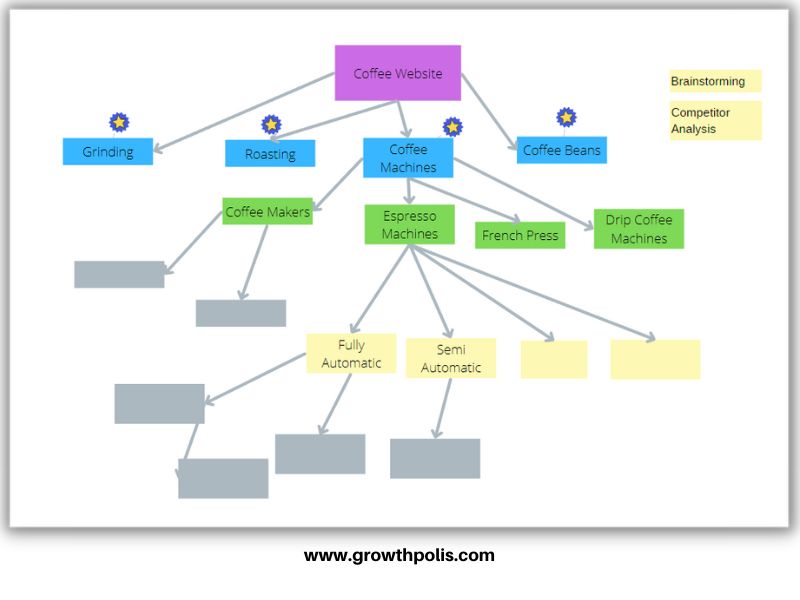
A mind map like this lets you see the shape of your site in a few minutes — where your topic clusters or content hubs naturally are, before you've written a word.
This step also includes writing down who your actual competitors are, by name. Once you genuinely can't think of anything new to add, move on.
Step 2: Competitor Analysis for KYC (Know Your Competitors)
This step exists to catch what Step 1 missed. Your mind map from brainstorming almost always looks incomplete at this point — competitor analysis is what fills in the categories and topics you didn't think of on your own, because you're not the only person who's mapped this niche.
Step 3: Identify Topic Clusters or Content Hubs
Now look for nodes on your tree with several branches underneath them — “Coffee Machines” is a good example from the mind map above. These nodes are your pillar page candidates: an in-depth resource that every related sub-topic links back to, mirroring the structure you already sketched out.
One way to sanity-check whether you've picked the right clusters: look at how many of your competitors have a dedicated pillar-style page for that same node. If two or three established sites in your niche all have one, that's a signal the topic supports a hub, not just a single article.
Step 4: Keyword Research
Only now do you actually start pulling keywords — and critically, you do it by topic, not by niche as a whole. That ordering matters, and I'll explain why below.
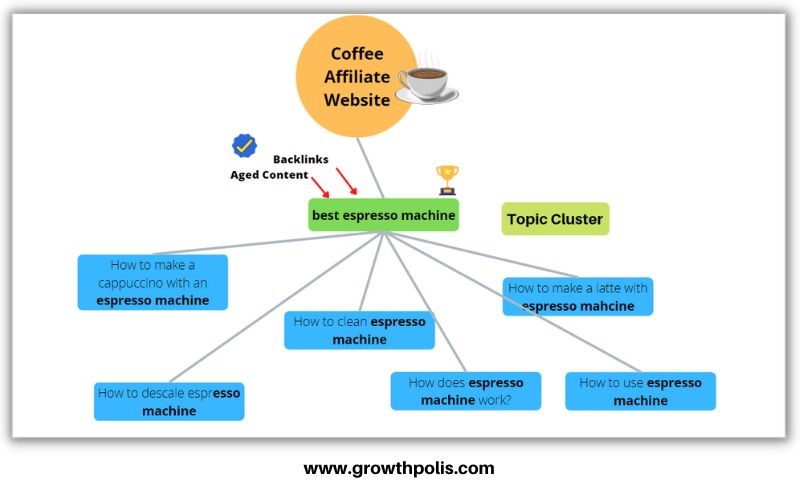
Let's look at “espresso machines” as a topic cluster. Pull every related keyword, be it commercial, navigational, or informational.
Drop them into the matching branch of your mind map.
Repeat for every cluster.
Why This Strategy Actually Works
Before the advantages — a quick opinion. There's a lot of noise right now about zero-volume and low-competition keywords as a shortcut. I'm not against them, but most people using them are missing the strategy part entirely — they think writing on low-competition keywords is itself the SEO strategy. It isn't. It's one ingredient.
Mix your topic clusters with all keyword types. In the espresso machine cluster, “best espresso machines” is high-volume and high-competition. And mostly high-authority sites with strong backlink profiles will rank there. That's exactly why most SEO gurus will tell new sites to avoid it.
I'd tell you to write it anyway — as part of a complete cluster, not as your first article.
The core of this strategy is finishing an entire cluster before moving to the next one. That's what builds topical authority: rank on the smaller keywords in a cluster first, and Google starts trusting your site on that topic as a whole, which makes the harder keywords in the same cluster — and even the next cluster — easier to rank for than if you'd tackled them cold.
There's a customer-journey reason too. When someone finds you through a low-competition, informational keyword and the article delivers, their next move is often searching for something closer to a buying decision in this case, “best espresso machine” If you haven't written that article because it looked too competitive for a new site, that visitor leaves to find the answer somewhere else, and the trust you just built gets undercut right when it mattered most.
One honest caveat on timing: high-competition keywords generally won't rank quickly on a brand-new domain regardless of how good the article is — Google appears to weight some amount of site age and accumulated trust before ranking new content competitively on contested terms. Publishing the article early as part of your cluster is still right; expecting it to rank in month one usually isn't.
A Few Honest Limits of This Approach
- It's slower than chasing individual low-competition keywords. If you need fast wins, finishing a whole cluster before moving on will feel inefficient — the payoff is in months 4–6, not week one.
- Results depend heavily on niche competitiveness. A 6-month authority timeline is realistic for a moderately competitive niche with consistent publishing; a highly contested niche (finance, health, broad e-commerce) will likely take longer no matter how well the clusters are built.
- This doesn't replace technical SEO or backlinks. A well-structured topic cluster ranks faster than scattered content, but it isn't a substitute for a technically sound site or for building some authority signals outside your own content.
FAQ
How long before a new website starts ranking with this strategy?
Roughly 6 months for a full topic cluster to gain traction in a moderately competitive niche, assuming consistent publishing — faster in low-competition niches, slower in highly contested ones.
Should I avoid high-competition keywords on a new site?
No — include them in your topic clusters from the start, but don't expect them to rank first. Publish them as part of a complete cluster and let the site build authority around them.
What's the actual difference between a keyword research method and a keyword research strategy?
A method is how you use a tool to find keywords. A strategy is how you sequence and cluster those keywords to build topical authority — the method matters far less than the sequencing.
If you'd rather have someone build the cluster map and content briefs for you instead of doing this manually, that's the kind of SEO strategy work Growthpolis does for clients — feel free to reach out if that'd save you the time.
6 thoughts on “How to Do Keyword Research for a New Website?”
Comments are closed.