If you run a Shopify store in a competitive niche, you already know the frustrating part of SEO. You're not fighting for rankings against one competitor. You're fighting against 15 of them, plus two or three big legacy brands with a 10-year head start and a content team three times the size of yours.
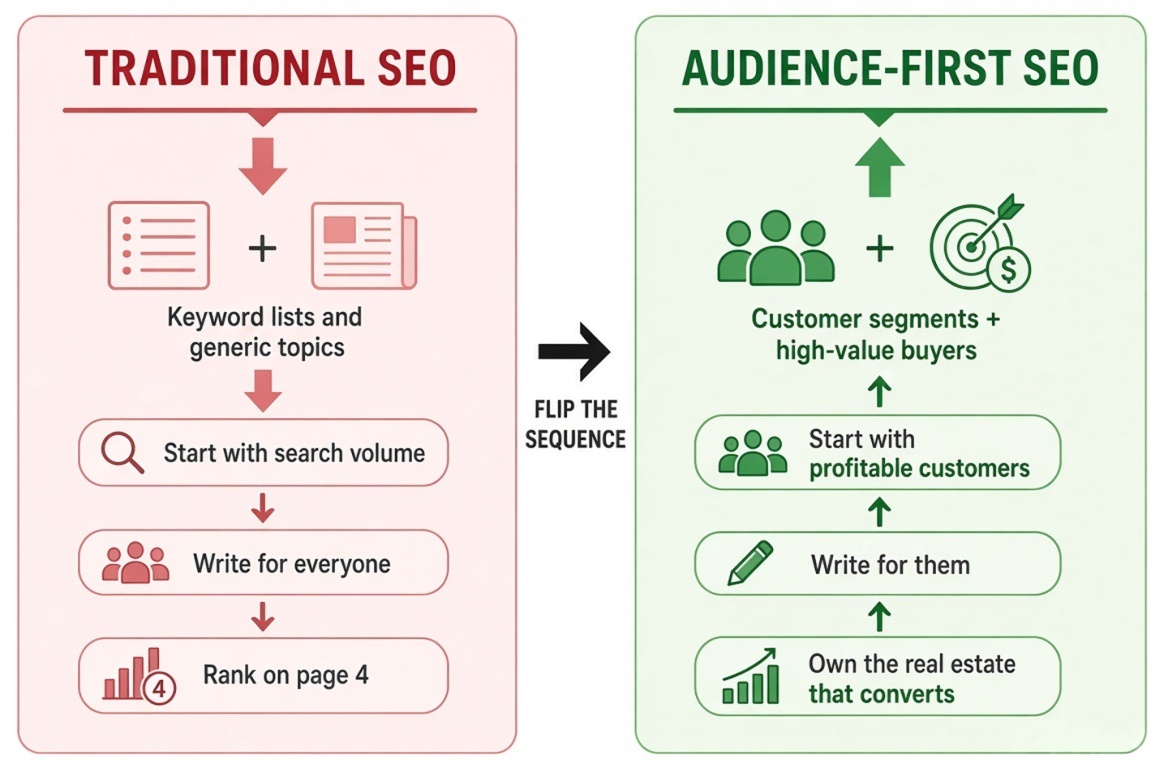
Most Shopify owners respond to this the same way: find every keyword with decent search volume in your category, write content for all of them, and hope enough of it sticks. I've watched this approach eat months of budget and produce a pile of blog posts that rank on page 4, if at all.
The problem isn't effort. It's the starting point.
Audience-first SEO flips the usual order. Instead of asking “which keywords have the most search volume,” you start by asking “which customers actually drive my revenue,” and you build your keyword research, content, and even your outreach around answering their questions first. Volume becomes a secondary filter, not the starting point.
This isn't a new tactic wrapped in a trendy name. It's closer to a change in sequence — and for a smaller Shopify brand competing against bigger names, that change in sequence is often the entire difference between ranking and not ranking.
What Audience-First SEO Actually Means
Traditional SEO organizes itself around topics. You pick a category — say, “sarees” or “handmade candles” or “resistance bands” — and you build a keyword list and content calendar around everything people search for in that category.
The problem is that a single topic serves very different people. Someone searching “cotton saree for daily wear” and someone searching “banarasi silk saree for wedding” are technically in the same category, but they have almost nothing in common — different budgets, different intent, different reasons to buy. Content written to please both of them usually ends up thin and generic enough to satisfy neither.
Audience-first SEO starts one step earlier. Before you open a keyword tool, you decide: which customer segment is actually worth the most to my store? Then you research keywords, gaps, and content ideas through that lens, not the other way round.
The tactics don't change — you're still doing keyword research, still doing content gap analysis, still building content briefs. What changes is which question comes first.
Why Chasing Search Volume Backfires for Smaller Shopify Brands
Here's the part most SEO advice skips: higher search volume rarely means higher revenue.
Long-tail, specific searches convert far better than broad ones. Broader, high-volume keywords convert at around 11%, while longer, more specific search phrases convert at closer to 36% because the person searching already knows what they want. That gap alone should change how you prioritize a keyword list.
It gets more relevant when you look at what's actually dragging down ecommerce conversion rates in the first place.
When a Shopify store's conversion rate sits well below 1%, the underlying issue is usually one of two things: a broken funnel, or the wrong traffic arriving in the first place. I've opened Search Console reports for stores getting 3,000+ monthly clicks and single-digit orders, and almost every time, the blog content was written for browsers, not buyers — ranking for the topic, missing the audience.
This is also why audience segmentation now sits ahead of even conversion rate optimization on marketers' priority list — it's the most-used optimization tactic today, narrowly ahead of CRO itself. The industry has already figured out that fixing “who's arriving” moves the needle harder than fixing what happens after they land.
For any brand without a Fortune 500 marketing budget, this matters twice as much. You don't have the resources to rank for everything. You have to be right about the few things you go after.
The Audience-First SEO Framework
Here's how I actually apply this on a store, in three steps.
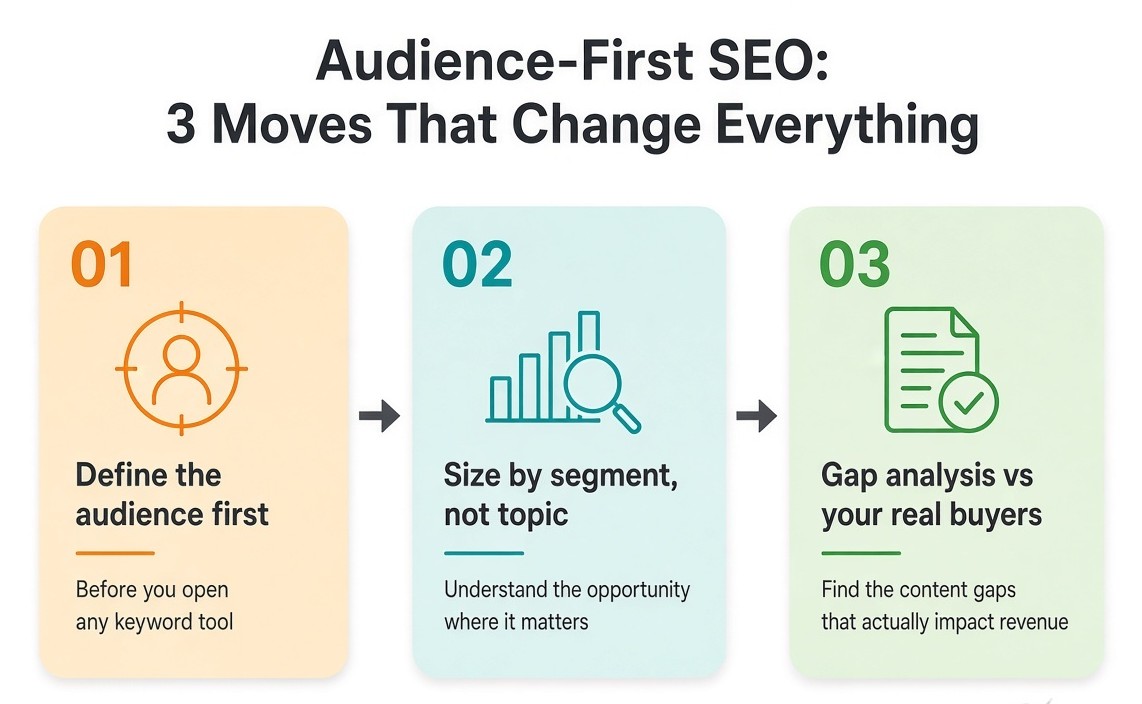
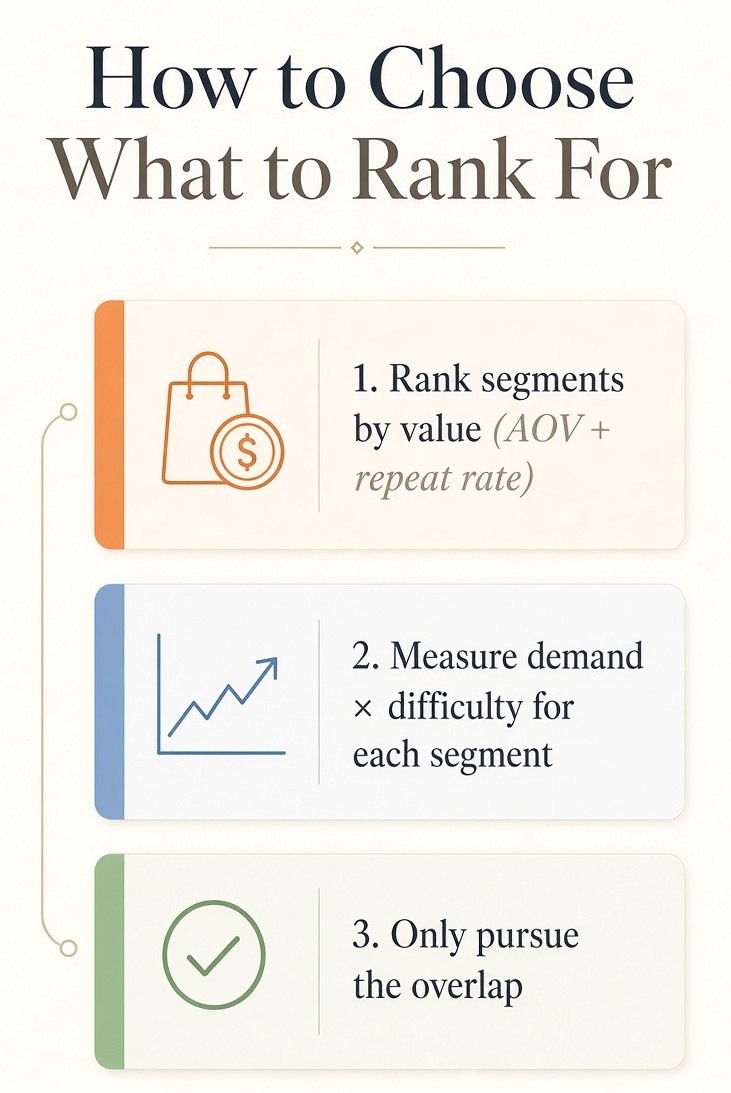
Step 1: Rank Your Customer Segments by Value, Not by Size
Before touching any SEO tool or Google Keyword Planner, pull your Shopify order data. Segment your customers by average order value, repeat purchase rate, and category. You'll usually find your “biggest” segment by traffic isn't your most profitable one.
A saree brand, for instance, might get the most search volume for everyday cotton sarees, but its highest average order value and repeat-purchase behavior often comes from a smaller segment shopping for wedding or festive wear. If you're writing content purely by search volume, you'll end up over-serving the segment that spends the least and buys once.
Step 2: Size the Opportunity Segment by Segment, Not Category by Category
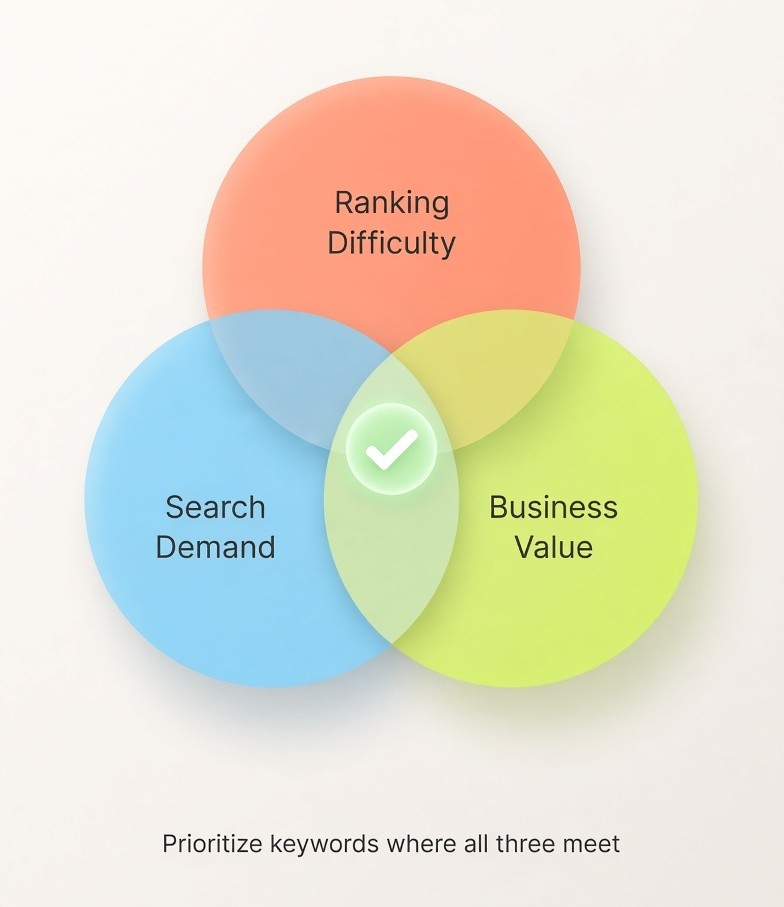
Once you know which customer segments matter most, look at three things for each one: search demand, ranking difficulty, and how much that segment is actually worth to you. Don't just look at a single blended search volume number for “sarees” or “candles” — break it down by who's searching.
The segments where demand, low difficulty, and high value overlap are your priority list. This is usually a much shorter list than your original keyword sheet, and that's the point — you're not trying to cover everything, you're trying to win the segments that matter.
Go one layer deeper here.
Read the reviews on your own product pages and your competitors'.
Check Reddit threads and Facebook groups in your niche or wherever your target audience hangs out.
Look at your own customer support chats.
You'll pick up the actual phrases your priority audience uses — which are often nothing like the generic keyword suggestions a tool spits out.
Step 3: Run Content Gap Analysis Against That Priority Audience, Not the Whole Category
This is the step most Shopify owners skip entirely, and it's where the real opportunity usually is.
Instead of comparing your blog against a generic list of “top saree blog topics,” check specifically where you're missing content for your priority segment. In almost every store I've audited this way, I've found content gaps sitting two or three pages deep in Google — pages that were never written with a specific buyer in mind, just written to “cover the topic.”
Once you rewrite or create content aimed squarely at your priority audience's actual questions, those pages tend to move fast, because they're finally answering something specific instead of something generic.
Finding the Golden Nuggets: Where Smaller Shopify Brands Actually Win
This is the piece that matters most if you're a smaller brand up against bigger names with bigger budgets: you cannot out-produce them on content volume, and you shouldn't try.
What you can do is get more specific than they will bother to get. Big brands write for the broad category because they need volume at scale. A smaller brand that goes narrow — writing directly to the exact customer segment that pays the most and buys again — ends up owning search real estate that the bigger brand never fully claims, simply because it wasn't worth their time to go that granular.
I saw a version of this play out with a Mumbai-based saree brand I worked with — organic sessions grew 142% and monthly sales jumped 161% in under three months, not by chasing every saree-related keyword, but by fixing the technical foundation and prioritizing the content and collections that actually mapped to their paying customers, not just search volume. I've written up the full breakdown of what was fixed and why in this Shopify case study, if you want to see the mechanics.
The pattern holds across niches. The store that wins isn't the one with the most content. It's the one whose content actually matches who's buying.
Audience-First SEO Beyond Google: Digital PR and AI Search
Once you know your priority audience, the same research tells you where to build backlinks and where AI tools like ChatGPT or Google's AI Overviews are likely to pull answers from.
Instead of chasing “high domain authority” sites in your general category for backlinks, look at where your specific audience actually spends time — niche publications, community forums, influencer roundups, even comment sections on YouTube reviews in your space. A backlink from a smaller site your actual buyer reads is often worth more than a generic guest post on a broad industry blog nobody in your audience visits.
This same audience map is what should guide which of your pages you optimize for AI search visibility first — the ones answering your priority segment's specific questions are the ones most likely to get pulled into an AI-generated answer, because they're the most specific and least generic content in the space.
FAQs
What is audience-first SEO?
It's an SEO approach where you define your most valuable customer segment before doing keyword research, then build your keyword targeting, content, and content gap analysis around that specific audience instead of a broad topic or category.
How is audience-first SEO different from regular keyword research?
Regular keyword research usually starts with search volume and works backward to audience. Audience-first SEO starts with your highest-value customer segment (based on order value, repeat purchase rate, or category) and only then looks at keywords and content gaps for that segment specifically.
Is audience-first SEO only useful for large brands?
It's actually more useful for smaller Shopify brands. Big brands can afford to cover a whole category. Smaller brands get more value from going deep on the specific segment that actually buys from them, since that's where they can realistically compete and win.
How do I find my priority audience if I don't have much order data yet?
Start with whatever you have — even 50-100 orders is enough to spot patterns in average order value and repeat behavior. Combine that with reviews, customer support conversations, and any social comments to understand who's actually engaging, then build your keyword and content plan around that group first.
Where This Leaves You
You don't need a bigger content team to compete with bigger Shopify brands. You need a sharper idea of who you're writing for before you write anything.
Start with your order data, not your keyword tool. Find the segment that actually pays. Build your content and technical priorities around them. That's audience-first SEO, and it's usually a smaller, more focused list of things to do — which, if you're running a lean Shopify store, is exactly the point.
If you want a second pair of eyes on where your store's current content is missing your actual buyers, that's the kind of audit I do for Shopify stores regularly — happy to take a look.
1 thought on “Audience First SEO Strategy”
Comments are closed.